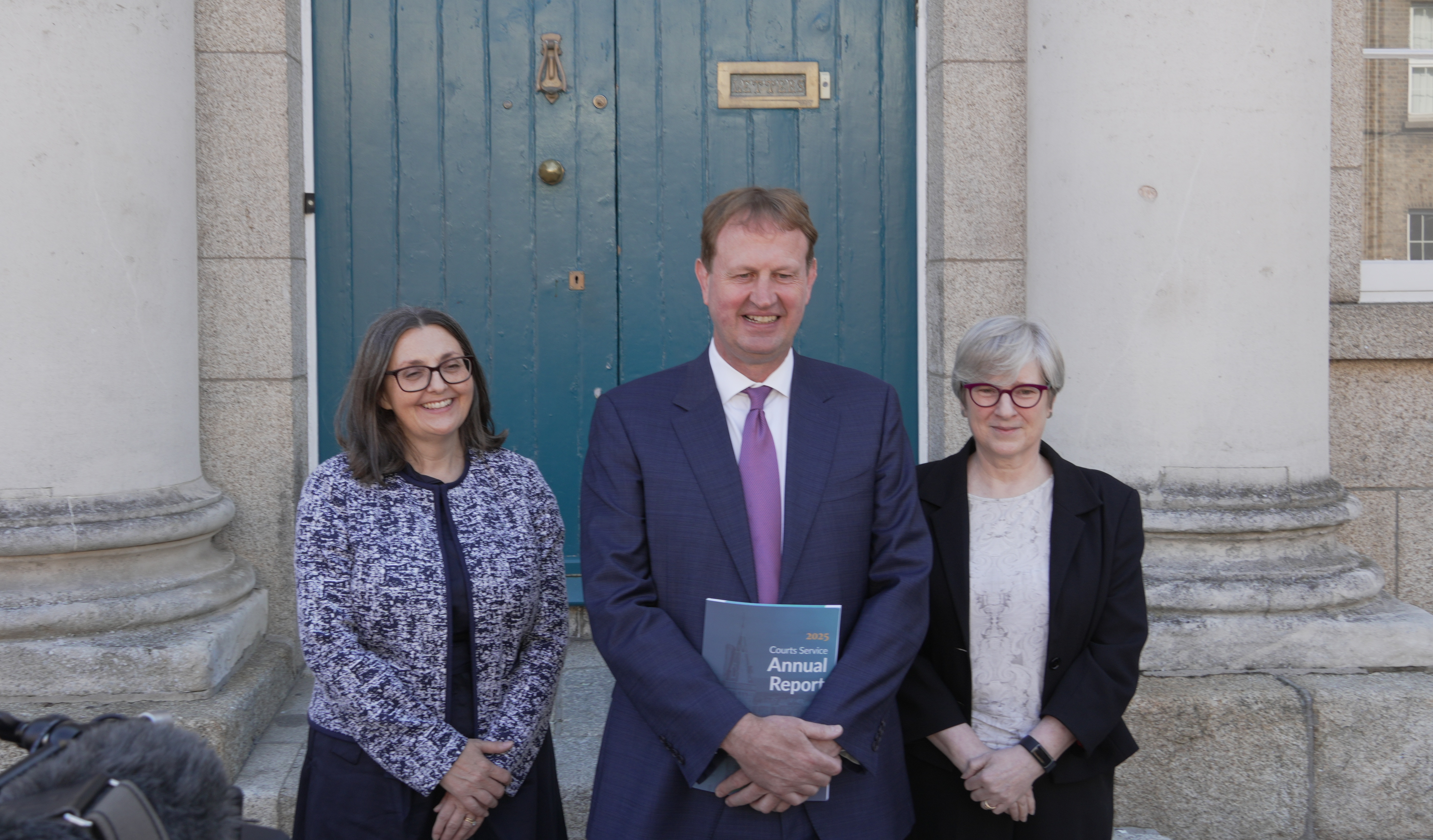
The 2025 Annual Report of the Courts Service, published today, shows a courts system that remained exceptionally busy while continuing to modernise and improve services for court users.
The report marks the halfway point of the Courts Service's ten-year Modernisation Programme. It highlights major progress in digital services, improved case management, better use of data, and increased access to technology across the courts.

Read the 2025 Annual Report (PDF)
Watch the 2025 Annual Report Highlights Video
Key figures from 2025
The report shows:
- 379,262 new criminal matters were presented to the courts.
- 337,416 criminal matters were resolved.
- The courts completed 150,766 civil cases during the year.
- 173 courtrooms are now technology-enabled.
- The District Court made 1,839 Civil Restraining Orders during the first full year of the new legislation.
- Drugs cases in the District Court increase by 8% year on year
- 58% of the 444 sentences handed down for Rape (including attempted rape) are for ten years or more.
- 500 court staff members were using the new Unified Case Management System (UCMS) across 7 areas of work
The Minister for Justice, Home Affairs and Migration, Jim O'Callaghan, said:
I wish to commend the Courts Service today, for its excellent work throughout this past year and unwavering commitment to ensure the smooth running of our courts across the country.
I am committed to ensuring adequate resources for the Courts Service, so that it can support the judiciary and provide an excellent service to all users of the courts.
The Judicial Planning Working Group was established to consider the number and type of judges required to ensure the efficient administration of justice over the next five years. This led to the appointment of an historic 24 additional judges in 2023.
The Courts and Civil Law (Miscellaneous Provisions) Act 2025 was enacted in January 2026 and provides for a further additional 21 judges spread across the various courts. This marks an approximate 25% increase in judicial numbers since 2023.
This year we mark the centenary of the Court Officers Act 1926. To this Act we owe the established, modern administrative framework of our courts system, defining the roles and functions of the judiciary. Ireland's long-standing reputation for judicial independence and rule of law has been a defining strength of our court system and an important source of stability.
Last year marked the half-way point for the Courts Service ten-year Modernisation Programme and new models of work have been advanced across its administrative system. By embracing new technologies and investing in court administration the judiciary can continue to deliver justice effectively.
The Chairperson of the Board of the Courts Service, Ms Justice Aileen Donnelly, speaking on an ever-changing pattern of court case numbers, said:
This is often as a result of changes in legislation, policing activity by An Garda Síochána and the myriad of organisations who investigate/prosecute various legislation and regulations. It can also reflect changed attitudes and activity in society as a whole.
She pointed out the report shows drugs cases of a less serious kind in the District Court increased by 8% year on year, increasing the workload of that jurisdiction.
She said,
It should be noted that Road Traffic offences show a 22% reduction over seven years. It might well reflect a change in attitudes amongst the driving public to road safety, and compliance with rules of the road, as increased awareness campaigns and enforcement have taken affect.
She also noted that new sexual offences show an increase of 13.6% over two years, perhaps reflecting a greater level of reporting and follow up of these crimes.
CEO highlights transformation and service improvements
Courts Service Chief Executive Officer Angela Denning said 2025 was the year when investment in the Modernisation Programme began to translate into visible results.
By the end of 2025, the Courts Service had reached the midpoint of our ten-year Modernisation Programme. While much of the work undertaken between 2021 and 2024 focused on building capability, strengthening resources and laying the foundations for change, 2025 was the year in which we began to see that investment translate into tangible results.
Ms Denning said the Courts Service continued to deliver major reforms while maintaining day-to-day court operations.
She highlighted the growing use of the Unified Case Management System, which is replacing approximately 150 legacy information technology systems and providing a single digital platform for court operations, online filing and improved access to information.
The Courts Service also completed the nationwide rollout of the Courts Portal for Circuit Court family law filings and launched a pilot service allowing probate applications to be submitted online.
Supporting court users
The report highlights a range of initiatives designed to make court services easier to use.
In 2025, the Courts Service introduced a new suite of District Court family law forms written in plain language and designed with accessibility in mind. The reforms reduced 37 forms to 7 standardised forms for use nationwide.
The Courts Service also completed a major upgrade of courts.ie. The website achieved a National Disability Authority accessibility score of 100%, making it the first major national Public Service organisation to reach that standard.
Reflecting changes in society
The report shows how court demand continues to reflect wider changes in society.
District Court drugs cases increased by 8% during the year, while Public Order and assault cases increased by 11% over 2 years. Applications under domestic violence legislation continued to rise, increasing by 34% since 2019.
The report also records a 35% increase in asylum, immigration and citizenship judicial review cases in the High Court during 2025. Additional judicial sittings helped maintain stable waiting times despite the increased workload.
Civil Restraining Orders
Ms Denning said:
One example of the system adapting to significant change was the first full year of operation of the Civil Orders against Relevant Conduct legislation, commonly known as Civil Restraining Orders.
During 2025, the District Court made 1,839 such orders. While often associated with stalking or harassment, the legislation has a much broader application, covering issues such as neighbour disputes, certain family-related matters outside domestic violence legislation, and cases involving bullying.
As with any new and complex area of law, challenges emerged as court users, legal professionals, judges and court staff became familiar with the legislation. The volume of applications has placed considerable demands on already busy District Courts. In response, we initiated a review of processes and supporting information towards the end of the year, with the aim of improving the experience for all those involved.
Looking ahead
As the Modernisation Programme enters its second half, the report points to continued investment in digital services, improved access to information and more efficient ways of working.
Ms Denning said:
Having reached the halfway point of our Modernisation Programme, we are now entering the phase where many of the long-term benefits will become increasingly visible. We look forward to continuing this work together as we build a courts system that is more accessible, more efficient and better equipped to meet the needs of the future.
The full Annual Report provides detailed information on court activity, modernisation projects and performance across all jurisdictions during 2025.
Criminal Case Numbers – improved disposal and resolution of cases across the system
379,262 new criminal matters were presented to the Courts last year compared to the 390,158, new cases in 2024. 337,416 criminal matters were resolved.
Serious Crime Cases finalised increase greatly over three years. The number of new offences of more serious crime numbered 21,571 last year slightly down from 22,822 in 2024, but remains up from 19,569 offences in 2023 .
The courts finalised 29,611 cases relating to serious offences last year – up from 27,821 in 2024; 26,486 in 2023; and 24,242 in 2022 – showing that the courts finalised and cleared 22% more serious cases last year compared to three years ago.
The Court of Appeal
The Court of Appeal had 341 new criminal appeals last year – up from 308 in 2023. The Court disposed of 269 appeals in respect of 2,014 offences (304 appeals in respect of 1,847 offences in 2023).
The Central Criminal Court
In the Central Criminal Court, with additional judges following the implementation of Judicial Planning Working Group recommendations, the disposal rate for cases has more than doubled over the last 5 years.
The court also introduced a Juvenile Protocol, which in its first year of operation saw waiting times for cases reduce from 20 weeks to 8. It saw 65 cases involving minors fast tracked.
Sentences in Rape Cases
The Central Criminal Court - which largely deals with murder, attempted murder and rape cases - saw trials relating to 1,149 offences, with a further 509 offences pleaded guilty to.
New cases received involved 2,506 offences involving 476 defendants.
444 sentences for Rape (including attempted rape) were handed down last year in the Central Criminal Court. This was made up of 261 prison sentences, 169 prison sentences partly suspended, 2 fully suspended and 14 detention orders for juveniles.
Of the 444 sentences for Rape 259 received over 10 years imprisonment, 123 between 5-10 years, 58 between 2-5 years.
There were 463 prison sentences for other sexual offences, 51 partly suspended prison sentences, 2 fully suspended and 17 detention orders for juveniles.
58% of the 444 sentences handed down for Rape (including attempted rape) are for ten years or more.
Circuit Criminal Court:
In the Circuit Criminal Court positive progress is being made to reduce the number of cases on hand which has decreased by 18% over the last 5 years even with high volumes of new incoming cases.
- The Circuit Court issued 16,068 sentences for more serious crime last year, up from 14,858 in 2024, and 14,002 the previous year: this included 4,235 sentences of imprisonment, 2,236 suspended prison sentences, 593 probation orders, 198 community service orders, 3,833 bonds to keep the peace.
- The District Court sent 19,047 more serious offences involving 6,784 defendants to the Circuit court last year. This was up from the 16,875 more serious offences sent to the Circuit Court in 2023, involving 6,271 defendants. An increase over a two year period of 13%.
- Of the cases resolved by the Circuit Court 14,713 offences were pleaded guilty to, 1,068 saw conviction following a trial with 571 acquittals (along with other outcomes).
District Court
The District Court saw a decrease by 7% in the total number of offences listed, while the number of adjournments decreased by 4%.
- Drugs accounted for 30,018 new cases before the District Court last year, compared to 27,783 in 2024. An increase of 8% year on year.
- Larceny / Fraud and Robbery totalled 38,219 last year down from 39,038 new cases in 2024, but up from 33,849 new cases in 2023. A 13% increase over two years.
- Public order and assault cases totalled 48,537 last year up from 47,956 in 2024, and 43,750 new cases in 2023. This shows an increase of 11% over two years.
- Road Traffic offences accounted for 175,328 new cases in 2025, down from 185,578 in 2024, and slightly up from 170,839 in 2023. Over seven years the number are down from 226,000 in 2019; - almost an 22% reduction.
- 3,648 new sexual offences were received by the District Court last year – almost the same as the 3,650 in 2024 – yet up from 3,211 the previous year an increase of 13.6%. in 2 years.
- Juveniles before the District Court faced charges in relation to 574 drugs matters, 1,070 larcenies, 651 public order matters (down from 756 in 2024) and 853 road traffic matters (down from 1,048 in 2024) Juveniles charges relating to public order fell 14% year on year and those relating to Road traffic matters fell by 18.6%.
Civil Court Statistics
New Civil cases across all courts increased to almost 188,000 last year up from 184,000 in 2024, and from 180,000 in 2023, 170,000 in 2022, and 140,365 in 2021. That an increase in new civil cases of 34% over five years.
The courts completed 150,766 civil cases last year up from 148,120 in 2024, 143,644 in 2023 and 137,000 in 2022. The Courts finalised 13,766 more civil cases last year than three years previously.
Most of the increases in the civil area occurred in the high court where 21,740 new cases were initiated last year. This was an increase on the 2022 figure of 15,971. Over three years the High Court has seen an increase in new cases of 36%.
Personal Injuries Awards
There were 14,661 new personal injury cases across the courts in 2025. This is up from 12,989 in 2024, and 13,434 in 2023. Yet in 2025 there were 33 % less new Personal Injury cases than in the pre covid time of 2019 – when the figure was 21,981
An increase in the amounts awarded last year saw €210 million awarded in the High Court. This followed a major reduction in the amounts awarded in 2024 where they had reduced from €256 million in 2023 to €135 million in 2024. (There was an increase in the resolution of cases of clinical negligence last year, up to 130 from 99 the previous year).
At Circuit level awards dropped from €16 million in 2023 to under €13 million in 2024 and under €12 million in 2025.
At District Court level awards were €2.2 million in 2023, €1.5 million in 2024, and €1.65 million in 2025.
In total the level of awards for personal injury remained less across the courts by over 18.5% last year compared to 2023.
Other areas in the Civil Courts:
- Asylum Cases: Despite an increase of 35% in the number of Asylum, Immigration and Citizenship (AIC) based judicial review cases issued in 2025 (1,082 new cases last year) waiting times remained stable. This was due to additional judicial sittings during the legal terms time to manage the increased caseload. In addition, 8 sittings of the Asylum pre-leave list took place during the Long Recess Pilot Project.( see note on P 28 of the report).
- Possession Cases: Possession cases regarding property increased to 1,650 new cases last year up from 1,135 in 2024, 1,091 in 2023, and 898 in 2022: showing a 46% increase over four years. The Circuit Court granted 207 possession orders last year – up from 141 in 2024, but down from 212 in 2023.
- Recovery of debt cases decreased slightly to 21,682 new cases last year, from 22,584 in 2024, yet up from 20,492 cases in 2023, and 17,291 in 2022. This is a 25% increase over four years.
- Execution orders following judgments in debt cases: The number of such applications was 1801 in 2025, up from 1,608 in 2024, and 843 the previous year. An increase of 113% over two years.
- Regulation of Professions: relating to appeals or confirmations of findings of regulatory authorities of registered professions – increased from 189 cases in 2023, to 232 new cases in 2024, and 235 in 2025: a 24% increase over two years.
- Extradition: Applications for extradition increased to 344 last year up from 265 in 2024. An increase of 30%.
- Planning and Environment List: New cases numbered 205 last year, down in number from 241 new cases in 2024, but up from 108 in 2023.
- Small claims numbered 2,565 in 2025 up from 2,081 in 2025 an increase of 23%. Approximately 75% of such cases are resolved out of court.
- Divorce cases applied for last year totalled 5,047, slightly up on the 5,004 cases in 2024, but down from 5,218 in 2023, and 5,551 in 2022.
- Domestic Violence: In total the District Court received 27,429 new applications for protections under Domestic Violence legislation last year. This is up from 25,270 in 2024, 25,570 in 2023, and 23,356 in 2022. Over seven years there has been a marked increase of 34% increase in such applications (The figure in 2019 was 20,501).


